A clear sense of musical pitch does not require every component of a sound to belong to a perfectly harmonic series. The ear can derive a convincing pitch from a complex spectrum when important frequency components form sufficiently stable relationships and persist long enough to establish a tonal identity.
A harmonic series consists of frequencies related by whole-number multiples of a fundamental frequency: 1×f, 2×f, 3×f, 4×f, and so forth. A partial is any frequency component within a complex sound. An overtone is a partial above the fundamental. Harmonic partials occur at whole-number multiples of the fundamental; inharmonic partials do not. WTT
Strings and many air-column instruments can produce spectra whose prominent components closely follow a harmonic series. The physics of a circular membrane is different. Its natural modal frequencies are determined by the solutions of the circular membrane wave equation and are not spaced as whole-number multiples of one lowest membrane frequency.
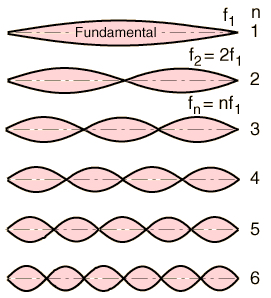
Fundamental and Harmonic Partials of a Vibrating String HP
Modes of a Circular Membrane
A circular membrane vibrates in two spatial dimensions. Its normal modes are commonly labeled (m,n), where m gives the number of nodal diameters and n identifies the radial order, or Bessel-function root.
With this notation, the number of internal nodal circles is n − 1. Thus every Mode (m,1) is in its first radial order and has zero internal nodal circles.
The Mode (0,1) pattern has no nodal diameters and no internal nodal circles. It is the lowest-frequency mode of the ideal circular membrane. Because its motion is axisymmetric, it couples relatively efficiently to the surrounding air and can contribute strongly to the initial radiated sound.
Mode (1,1) has one nodal diameter and no internal nodal circles. In a timpano it is particularly important because it contributes strongly to the sustained principal-tone region of the instrument.

Several Modes of an Ideal Circular Membrane:
(0,1), (0,2), (1,1), and (2,1)
The natural frequencies of an ideal circular membrane are proportional to the zeros of Bessel functions. Consequently, its modal spectrum is inherently inharmonic.

Mode-Frequency Ratios of an Ideal Circular Membrane HP
What Is an Ideal Circular Membrane?
An ideal circular membrane is a mathematical model. It is assumed to be perfectly circular, extremely thin and flexible, homogeneous, uniformly tensioned, fixed at its circular boundary, and vibrating without the influence of surrounding air. Dr. Dan Russell of The Pennsylvania State University provides extensive educational material on the vibration of ideal membranes and related systems. Dr. Dan Russell
A real timpano differs from this ideal model in several important ways. Its head has finite thickness and material structure, tension is applied through discrete mechanical hardware, the circumference is never perfectly uniform, and the membrane interacts strongly with the surrounding and enclosed air.
Nevertheless, the ideal circular membrane provides an essential starting point because many of the principal spatial patterns observed in a timpano can be understood as modified versions of these normal modes.
The Preferred Diametric Modes
A circular membrane theoretically supports an infinite number of modes. In a musical timpano, however, some modal families contribute much more strongly than others to the sustained sense of pitch. A particularly important sequence consists of Mode (1,1), Mode (2,1), Mode (3,1), Mode (4,1), and higher related first-radial-order modes. These are often described as the preferred diametric modes.

Preferred First-Radial-Order Modes of an Ideal Circular Membrane HP
Normalized to the frequency of Mode (1,1), the ideal circular membrane gives approximately:
| Mode | Ideal Membrane Ratio relative to (1,1) |
Typical Air-Loaded Timpani Region relative to (1,1) |
| (1,1) | 1.000 | 1.0 |
| (2,1) | 1.340 | ~1.5 |
| (3,1) | 1.665 | ~2.0 |
| (4,1) | 1.980 | ~2.5 |
| (5,1) | 2.289 | ~2.9–3.0 |
| (6,1) | 2.593 | ~3.4–3.5 |
The higher air-loaded values vary with instrument design, head properties, tension, and playing conditions. The first several preferred modes, however, illustrate one of the defining acoustical features of timpani: the surrounding and enclosed air alter the ideal membrane frequencies by different proportions.
How Air Loading Changes the Picture
A timpano head does not vibrate in a vacuum. It must move air above and below the membrane, and the enclosed air interacts with the geometry of the kettle.
This head-air-bowl coupling changes the natural frequencies and damping of the membrane modes. The absolute frequencies are lowered by air loading, but the amount of the shift is not proportionally identical for every mode.
Mode (1,1) is shifted proportionally more strongly than several higher preferred modes. As a result, when the spectrum is normalized to Mode (1,1), ratios such as the ideal membrane value of approximately 1.340 for Mode (2,1) can move toward approximately 1.5 in a real air-loaded timpano. Likewise, Modes (3,1) and (4,1) can move toward approximately 2.0 and 2.5.
The resulting sequence can therefore approach:
1 : 1.5 : 2 : 2.5
or, when expressed relative to an implied pitch one octave below Mode (1,1):
2 : 3 : 4 : 5
This is a quasi-harmonic relationship rather than an exact harmonic series.
Where Does the Pitch Come From?
Mode (1,1) is an important anchor of the sustained timpani tone. Modes such as (2,1), (3,1), (4,1), and higher preferred families contribute additional spectral information that can strengthen the ear’s sense of an organized musical pitch.
The approximate 2:3:4:5 relationship can also support a virtual or residue pitch corresponding to an implied fundamental below Mode (1,1). This missing-fundamental effect can contribute to timpani pitch perception, but it is only one part of the perceptual picture.
The audible pitch of a timpano depends on the combined behavior of the preferred modes: their frequencies, amplitudes, damping rates, radiation efficiencies, and temporal evolution.
The result is therefore better understood as a modal pitch than as the simple fundamental-plus-harmonics structure of a string.
What Clearing Contributes
Head-air-bowl coupling and clearing perform different acoustical jobs.
Head-air-bowl coupling helps determine where the preferred-mode frequencies lie.
Clearing helps stabilize the circumferential boundary condition from which those modes arise.
In an ideal circular membrane, each modal family with m > 0 is doubly degenerate. Two linearly independent angular basis functions share the same natural frequency, and any rotated realization of the mode can be formed from a combination of them.
Real circumferential asymmetry can lift that degeneracy. The formerly shared eigenfrequency may split into two nearby frequencies associated with preferred spatial orientations.
If the splitting becomes acoustically significant, different strike locations can weight those components differently. The player may then hear beating, shimmer, pitch drift, orientation-dependent pitch tendencies, or a less focused decay.
Clearing can be interpreted as the practical reduction of acoustically significant asymmetry in the membrane’s boundary condition. Small circumferential adjustments can reduce modal splitting and improve the stability of the principal-tone response.
This does not require mathematically equal tension at every point around the circumference. Real heads and instruments contain irregularities, and slightly different local adjustments may be required to produce a stable global result.
Strike Location: A Local Stroke, a Global Vibration
Where the player strikes the head matters because a localized force excites the available global normal modes with different strengths.
The strike is local, but the resulting vibration is global.
Changing strike position therefore changes the modal mixture and the relative amplitudes of the components that reach the ear. In the ordinary linear description, changing strike location does not change the natural eigenfrequencies themselves.
On a well-cleared drum, the principal pitch identity should remain convincing as strike position and playing dynamic vary within normal musical use, even though the timbre and relative modal amplitudes change.
The Sound Changes Through Time
Several modes are excited from the beginning of a timpani stroke. They do not wait to appear one after another.
What changes through time is their relative prominence.
Different modal components have different initial amplitudes and different damping rates. Some radiate energy efficiently and diminish relatively quickly; others persist longer. The balance of the spectrum therefore changes throughout the attack, sustain, and decay.
For example, the axisymmetric Mode (0,1) can radiate efficiently and contribute strongly to the initial transient, while the less efficiently radiating Mode (1,1) can persist longer and become particularly important to the sustained pitch impression.
Higher preferred modes contribute additional pitch and tone-color information according to their amplitudes and decay rates.
The resulting sound is an example of classical modal superposition: many normal-mode contributions coexist, and their changing balance forms the evolving sound of the instrument.
This visualization presents six first-radial-order diametric modes of an ideal circular membrane, from Mode (1,1) through Mode (6,1). The animation displays the patterns sequentially for clarity; in an actual timpani stroke, several modes may be excited simultaneously.
These modal patterns span the membrane and provide a useful foundation for understanding how a real timpano develops its quasi-harmonic pitch structure after interaction with the surrounding air, enclosed cavity, bowl geometry, and real boundary conditions.
For a broader discussion of timpani pitch and acoustics, please read Chapter 1, Chapter 2, and Chapter 3 of The Well-Tempered Timpani.
Pitch Without a Perfect Harmonic Series
The timpano demonstrates an important principle of musical acoustics: a convincing musical pitch does not require a textbook harmonic spectrum.
The ideal circular membrane begins with an inharmonic set of natural modal frequencies. In the real instrument, head-air-bowl coupling shifts the preferred-mode frequencies toward quasi-harmonic relationships. Mode (1,1) provides an important sustained pitch reference, while higher preferred modes and virtual-pitch mechanisms contribute additional evidence that the auditory system can organize into one musical pitch identity.
Clearing contributes another part of that stability. By reducing acoustically significant circumferential asymmetry, the player can reduce orientation-dependent differences and modal splitting that would otherwise blur or destabilize the pitch.
These are related but distinct pieces of the same acoustical system:
- Head-air-bowl coupling helps establish quasi-harmonic frequency placement.
- Degeneracy allows symmetry-related states within a modal family to share a frequency.
- Clearing can reduce acoustically significant symmetry breaking and modal splitting.
- Strike location and mallet behavior determine how strongly the available global modes are excited.
- Amplitude and damping determine how the modal balance evolves through the life of the sound.
- Pitch perception integrates these components into a musical identity.
The next question is therefore measurable as well as musical: how close to quasi-harmonic relationships do the preferred modes of an expertly prepared timpano actually come?
Historical measurements provide an important point of reference. In 1973, Arthur Benade documented the modal frequencies of a timpano prepared by Cloyd Duff. Those measurements offer a valuable example of the preferred-mode relationships present in an instrument cleared by one of the twentieth century’s most influential timpanists.
They do not define a universal numerical standard for every timpano. They give us something equally useful: a documented historical case that can be compared with modern acoustical measurements and with the underlying physics of the instrument.
That is where we turn next.