What gives sound a sense of pitch, one with a pleasing tone that is pleasurable to the human ear is a set of composite vibrations that are balanced and congruous. The term Harmonic is used to describe this balance or congruity and these vibrations can be explained with a sequence of numbers. When vibrations are whole number multiples of each other they are considered harmonic. When vibrations are not whole number multiples of each other, they are said to be inharmonic. The first vibration in the series is called the fundamental. The secondary vibrations are called overtones or partials. These secondary vibrations can be harmonic or inharmonic. WTT
Harmonic overtones (like those produced by strings or wind instruments) are not inherently present in timpani. Harmonics, by definition, are overtones that are whole number multiples of the fundamental frequency (e.g., 1×f, 2×f, 3×f). All harmonics are partials, but not all partials are harmonic. In timpani, the overtones are mostly inharmonic, meaning their frequencies do not align neatly as whole number multiples.
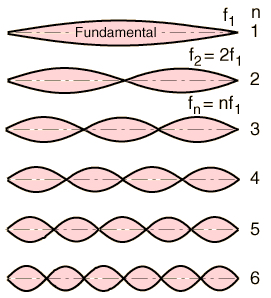
Fundamental and Harmonic Partials of a Vibrating String HP
Unlike strings and air columns that vibrate in one dimension, circular membranes (like timpani heads) vibrate in two dimensions. Their vibrational patterns are described using (m,n), where m is the number of nodal diameters (diametric modes), and n is the number of nodal circles (concentric modes). The lowest mode, (0,1), is concentric and does not significantly contribute to pitch perception. Instead, it generates a short, transient percussive sound. Pitch arises primarily from the diametric modes, particularly those with low m-values.

A vibrating circular membrane: Modes
(0,1) (0,2) (1,1) (2,1)
Timpani do not produce harmonic overtones in the strict physical sense. Therefore, the term “harmonics” should be used carefully and ideally avoided when referring to timpani overtones. These instruments generate inharmonic partials based on the modal structure of the vibrating membrane. Below is a table showing the frequency ratios of the first 12 modes of an ideal circular membrane. As you’ll notice, they are not whole number multiples of the fundamental..

Frequency Rations of the First 12 Modes an Ideal Circular Membrane HP
What is an ideal circular membrane? Dr. Dan Russell, The Pennsylvania State University defines an ideal circular membrane as:
“an absolutely round membrane, infinitely thin, perfectly flexible, completely homogeneous, evenly and uniformly tensioned where the outer circular edge of the membrane constitutes a fixed boundary condition in an “in vacuo” state (in a vacuum). This type of membrane exists in theory only”
Real timpani heads are subject to practical constraints: they are not perfectly uniform, are tensioned by discrete lugs, and are influenced by air and bowl acoustics. Nevertheless, their mode shapes closely approximate those of an ideal membrane. While an infinite number of vibrational modes exist, only a few contribute significantly to pitch perception. These are known as the preferred diametric modes.

Preferred Modes of an Ideal Circular Membrane HP
Since these mode frequencies are not harmonically spaced, they cannot theoretically produce a strong sense of pitch. However, under certain conditions, the preferred diametric modes can approximate a harmonic structure due to:
- Air loading by the Earth’s atmosphere
- Acoustic reinforcement from the kettle (bowl)
- Proper tensioning of the membrane
- Striking the head in locations that favor these modes
When optimally configured, this results in a quasi-harmonic spectrum with a missing fundamental (e.g., 2, 3, 4, etc., where “1” is implied but absent)..

Harmonic Alignment of the Preferred Modes
of an Air Loaded Membrane WTT
The lowest preferred mode, (1,1), is heard as the principal tone of the timpani. Higher modes such as (2,1) and (3,1) reinforce this tone, creating a spectrum that mimics harmonicity. Additional higher modes-(4,1), (5,1), (6,1)-further refine this impression, especially at higher tensions.
While timpani cannot produce perfect harmonic spectra, the best results come from a balance of the principal and reinforcing modes. If the head is well-tempered and struck correctly, the resulting pitch perception can be remarkably stable and pleasing. However, due to natural imperfections in tension and head geometry, the harmonic-like alignment will shift slightly as the point of contact changes around the circumference.
Ideally, the resulting spectrum, no matter where the drum is struck, will feature a strong, sustained fundamental (the principal tone), along with a present fifth, octave, tenth, and possibly twelfth. These elements collectively define the tonal character of the instrument.
When the drumhead is cleared (balanced, even-tensioned), the transient concentric modes quickly decay, leaving the sustained energy in the preferred diametric modes. As the drum continues to vibrate, these modes interact dynamically, creating a network of modal entanglement. This entanglement (while not quantum in a strict sense) describes how interacting modes collectively contribute to a unified, perceivable pitch structure: a kind of acoustic “congress of pitch zones.”
This visualization shows the six preferred modes of an ideal circular membrane. Starting from rest, the membrane is sequentially animated through Modes (1,1) to (6,1). These are the key contributors to the quasi-harmonic spectrum of timpani and span the entire circumference of the drumhead. For more information on how timpani produce pitch, please read Chapter 1, Chapter 2, and Chapter 3 of The Well-Tempered Timpani.
The discussion above explains how timpani can create a credible sense of pitch even though their partials are not inherently harmonic: a real drum works by persuading a small set of preferred diametric modes into quasi-harmonic alignment through air loading, bowl interaction, careful tensioning, and consistent striking. That is the mechanism. The next problem is less poetic and more useful: how close to “true” harmonicity can a timpano actually get, and how would we verify it in a way that is measurable and comparable across instruments, heads, and players? Because real drums and players vary, an explanation is not enough. We need data that can function as a benchmark, a defensible reference point for what “harmonic alignment” looks like when an expert clears a high-quality instrument. That is exactly where Benade’s 1973 measurements of Cloyd Duff’s timpano become the logical place to begin.